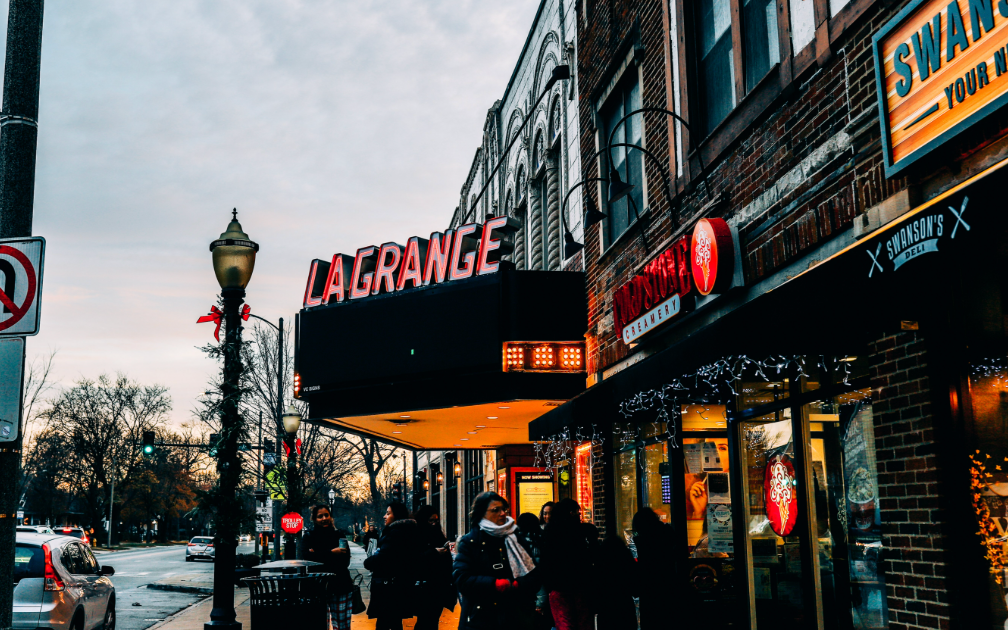
The rules governing what can open in downtown La Grange haven't had a serious update since 1991. A bowling alley needs a special permit. So does a children's play space. A trampoline park, an ice skating rink, a video arcade — all fall under categories the code treats as prohibited. The village's zoning code, built on a federal classification system developed in 1937 and last revised in 1987, reflects an older framework not designed for the kind of downtown La Grange is trying to become.
That's about to change.
The village issued a formal request for proposals this past March, seeking a consulting firm to lead a top-to-bottom rewrite of its zoning code. Proposals were due April 6, with a contract expected to be awarded by the Village Board in June. The village has budgeted $190,000 for the project.
The rewrite flows directly from La Grange Forward, the comprehensive plan the village adopted in November 2024 after roughly 18 months of community input. That plan laid out a vision for La Grange as a regional destination — a place families drive to for an evening out, not just a stop on the Metra line. Translating that vision into reality, the thinking goes, starts with zoning.
What Could Actually Change
The most tangible shift for residents may be in the kinds of businesses that can open downtown. Under current rules, many entertainment and experiential uses either require a special permit or are outright prohibited. The new code is expected to create clearer, more welcoming pathways for exactly these kinds of places.
When an escape room operator wanted to open here, for instance, the village's zoning code had no category for it. The code was eventually amended to create a special permit pathway — but only in one specific commercial district. It's the kind of workaround that has become routine, and that the rewrite is designed to make unnecessary.
At a Community and Economic Development Commission meeting in May 2025, commissioners debated how to attract more of what they called "experiential uses" — businesses that give people a reason to come downtown and stay a while, rather than just shop and leave. One commissioner argued that the current regulations were an impediment, pointing to neighboring communities like Glen Ellyn and Clarendon Hills as places offering more flexibility for drinking establishments in particular. Others pushed back, with one restaurant operator on the commission saying the existing rules had actually spurred innovation in his own business. The commission ultimately agreed the topic deserved deeper examination as part of the pending code rewrite.
That said, village officials are equally clear about what they want to preserve. The heart of the Central Business District will retain its emphasis on street-level retail. First-floor offices will remain restricted there, to keep storefronts active and pedestrian-friendly. The goal, as the comprehensive plan puts it, is a downtown that continues to carefully curate its mix of uses.
Why This Matters Beyond Downtown
The rewrite also takes aim at regulations that affect everyday residential life. The rules governing how big a house can be, how close to the lot line, how tall — known as bulk standards — will be updated to better reflect the actual character of La Grange's neighborhoods. One explicit goal is reducing the variance requests that currently send homeowners to public hearings for projects the village has been routinely approving for years anyway.
The new code is also expected to use flexible language to anticipate emerging trends like solar readiness and EV charging, so that future technology doesn't require yet another round of piecemeal amendments.
And for anyone who has ever tried to read the current zoning code, there's this: the rewrite is specifically required to be written in plain language, organized with graphics and tables, and published in a digital format accessible to non-experts — and ideally in multiple languages.
The Broader Stakes
La Grange is a small village — about 16,300 people, two and a half square miles — but its downtown punches well above its weight, drawing shoppers and diners from surrounding communities that lack a traditional main street. That economic activity is not incidental: with no large shopping centers and limited office and industrial properties, the health of downtown is directly tied to the village's tax base, and by extension, to the services and character residents depend on.
The new zoning code won't build anything by itself. But it will determine what's possible — and what isn't — for the next generation of La Grange.