After more than a year of data collection and two public open houses, La Grange Park's draft transportation plan for the 31st Street corridor arrives at its first formal committee review Wednesday morning — and the crash numbers alone make a strong case for action.
The Commercial Revitalization Committee meets at 9 a.m. June 10 in the Village Hall Board Room, 447 N. Catherine Ave. The meeting is open to the public and is the last committee stop before the plan advances to the Village Board for final approval.
381 crashes in five years
The 51-page draft, prepared by Kimley-Horn and Associates, opens with a stark crash analysis. Between 2019 and 2023, the corridor saw 381 collisions. Eighty-one percent occurred at or near intersections. Sixty-five involved injuries, including four classified as serious, and five involved pedestrians.
Crashes are concentrated in the most commercially active stretches: 40 between La Grange Road and Barnsdale Road, 30 between Kemman Avenue and Maple Avenue. Field observations flagged limited sight lines from parked vehicles and landscaping, wide crossing distances, and pedestrian signal timing that may not accommodate all users.
Two unsignalized intersections — Beach Avenue and Newberry Avenue — recorded 89 and 78 pedestrian crossings respectively during morning peak hours, driven largely by school travel and business traffic.
What the plan proposes
The plan covers 31st Street from La Grange Road to Maple Avenue, plus Barnsdale Road north to 26th Street. Corridor-wide recommendations include reducing the speed limit to 25 mph, enhancing crosswalks, adjusting traffic signal phasing, adding street trees, and incorporating the village's new branding elements.
Beyond those baseline changes, the plan details improvements at more than 20 specific segments and intersections, including the La Grange Road/31st Street intersection, the railroad crossing, the Kemman Avenue/Grand Boulevard node, and three segments of Barnsdale Road leading to the Community Park Recreation Center.
The village purchased 1024 Newberry Ave. in November 2024 for demolition and conversion to a municipal parking lot — a meaningful addition given that on-street parking along the corridor is limited to roughly 15 to 20 spaces on the north side of 31st between Beach and Newberry.
Village President Jim Discipio has described the ambition behind the plan plainly: "The goal is to increase vibrancy with tree-lined streets, new branding, flowers, signage, and a very family-friendly atmosphere."
How residents shaped it
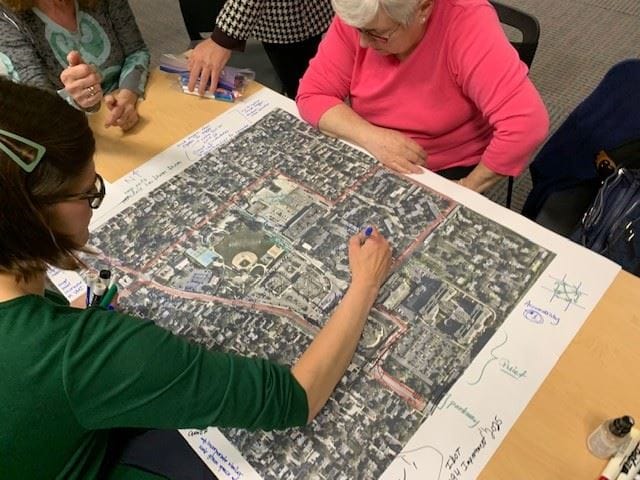
The plan reflects two rounds of public input. At the first open house in October 2025, residents praised the corridor's local businesses and growth potential but flagged narrow sidewalks, ADA challenges, unclear parking signage, and hazardous intersections. Their priorities: safer crossings, a more attractive streetscape, and better bicycle connectivity.
A second open house in March 2026 let residents respond to preliminary recommendations. Kimley-Horn's team had presented a vision organized around five goals: improving traffic and pedestrian safety, enhancing intersections, promoting walkability, supporting local business development, and integrating village branding.
How it was funded
The village secured $180,000 in federal funding through IDOT's Statewide Planning and Research Grant Program in early 2025, covering most of the $224,733 consulting contract the Village Board approved that July. Kimley-Horn brought on Span — the firm behind the village's Branding and Identity Plan — as a sub-consultant to ensure the corridor improvements align with La Grange Park's broader visual identity.
What comes next
The project timeline targets a final plan this summer and an implementation roadmap by fall 2026. No specific Village Board vote date has been announced.
Residents who want to weigh in have one last chance at the committee level before the plan moves to a board vote. Wednesday's 9 a.m. meeting at Village Hall is open to the public.